Two traditions, one set of birth details
Vedic vs Western astrology: compare your birth charts
Vedic astrology commonly uses a sidereal zodiac; Western astrology commonly uses a tropical zodiac. The same birth details can therefore produce different sign placements. Compare the zodiac reference, house system and interpretation before deciding that one chart is wrong.
By DrAstro · Updated
Free core chart. No sign-up needed. Birth time is optional.
The main differences at a glance
| Chart feature | Common Vedic convention | Common Western convention |
|---|---|---|
| Zodiac reference | Sidereal, using an ayanamsa such as Lahiri | Tropical, with Aries beginning at the March equinox |
| Familiar starting points | Moon sign, rising sign and lunar mansion | Sun, Moon, rising sign and planetary aspects |
| Timing methods | Planetary periods called Dashas, alongside transits | Transits and other timing techniques |
| Lunar divisions | 27 Nakshatras are used in many Jyotish techniques | Nakshatras are not standard in most Western practice |
| Houses | Whole-sign houses are common; other methods also exist | Several systems, including Placidus and Whole Sign |
| Planets and points | The lunar nodes, Rahu and Ketu, are important | Uranus, Neptune and Pluto are commonly included |
These are broad conventions. Individual astrologers and software settings vary. Both traditions can examine the Sun, Moon, rising sign, houses and planetary relationships.
Why the same planet can appear in a different sign
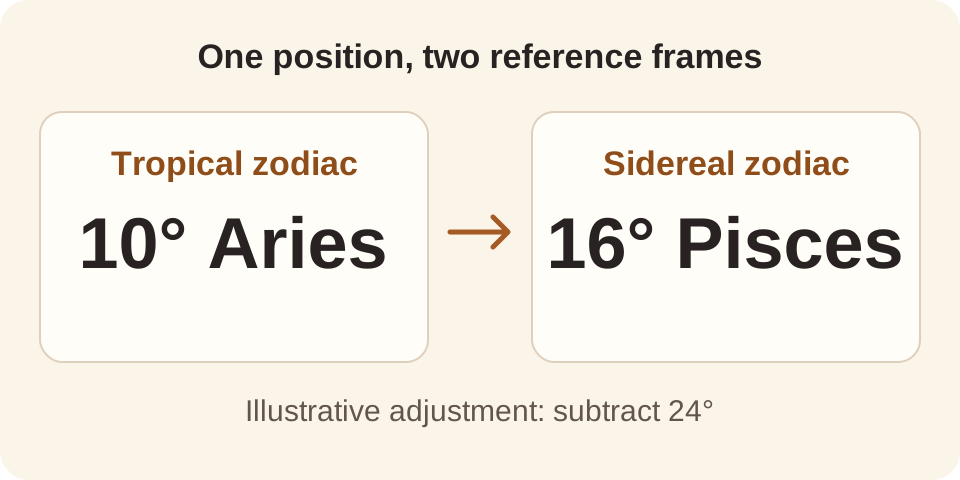
The tropical zodiac is tied to the equinoxes. A sidereal zodiac uses a star-referenced frame. An offset called an ayanamsa relates the two; its value depends on the date and the chosen convention.
For a simple illustration, take a planet at 10° Aries in a tropical chart. Subtracting an illustrative 24° offset places it at 16° Pisces in the sidereal zodiac. This is a numerical example, not a calculated DrAstro result or a fixed offset for every birth date.
That is why “I am Aries in one chart and Pisces in another” need not mean the birth details were entered incorrectly. The two charts may be using different reference frames.
Moon sign, Sun sign and rising sign are different questions
When someone asks for your sign, they may mean the Sun sign in popular Western astrology or the Moon sign, called Rashi, in a Vedic context. Comparing a Western Sun sign with a Vedic Moon sign also compares two different chart factors.
First compare the same planet in both charts. Then look at your Moon and rising sign separately. The rising sign and houses are especially sensitive to birth time and location. The Sun, Moon and rising sign guide explains what those labels refer to.
How to compare your own charts fairly
- Use the same birth date, local birth time and birthplace in both views.
- Check whether each view says tropical or sidereal. For a sidereal chart, check its ayanamsa setting when shown.
- Compare the same chart factor: Sun with Sun, Moon with Moon, and rising sign with rising sign.
- Check the house system before comparing house placements. Different systems can change house boundaries.
- Read the explanations within their own tradition. A difference in convention is not, by itself, a calculation error.
Create your free birth chart to start with one set of birth details, then explore the Vedic and Western chart views. See how DrAstro works for the steps before you begin.
How timing differs
In many Vedic readings, Dasha periods organize the interpretation into longer planetary chapters and smaller periods within them. Transits compare the sky at another date with chart placements; both traditions use transits, though their methods can differ.
A sign-based annual forecast is broader than either form of individual timing. The personalized versus general horoscope comparison explains that distinction before you read a yearly outlook.
Which system should you choose?
Start with the question you want to explore and the tradition you want to understand. Vedic chart views may be useful if you want to learn about Rashi, Nakshatras and planetary periods. Western views may feel familiar if you already follow tropical signs and aspects.
Neither tradition has established scientific evidence showing that it reliably predicts personal outcomes better than the other. A useful comparison makes the assumptions clear and lets you judge the interpretation in context. Our methodology page explains the calculation foundation without treating astronomical precision as proof of prediction.
Frequently asked questions
Why is my Vedic sign different from my Western sign?
The charts may use different zodiac reference frames, or you may be comparing a Moon sign with a Sun sign. Check the same planet, the birth details and the zodiac setting in each chart.
Are sidereal zodiac signs the same as astronomical constellations?
No. Sidereal astrology divides the zodiac into twelve equal signs. Astronomical constellations have unequal boundaries. A star-referenced zodiac should not be described as an identical map of constellation boundaries.
Can both charts be calculated from the same birth details?
Yes. The same date, time and place can be used for both. Differences can arise from the zodiac reference, ayanamsa, house system and other chart settings.
What is an ayanamsa?
An ayanamsa is the offset used to relate tropical and sidereal zodiac longitudes. Its value varies with time and with the convention selected, such as Lahiri.
Is Vedic astrology more accurate than Western astrology?
There is no established scientific basis for claiming that one tradition predicts personal outcomes more accurately. Compare the settings, methods and explanations rather than assuming one chart corrects the other.
Start with the same birth details
Create a free chart, then explore the Vedic and Western views. Check the settings as you compare.
Free core chart. No sign-up needed. Birth time is optional.