Choose the reading that fits your question
Personalized vs generic horoscopes: what changes?
A generic horoscope groups people by zodiac sign. A personalized horoscope starts with an individual birth chart, adding birth date, time and place, planetary placements, and the period being explored. The useful difference is the chart context behind the reading.
By DrAstro · Updated
Free core chart. No sign-up needed. Birth time is optional.
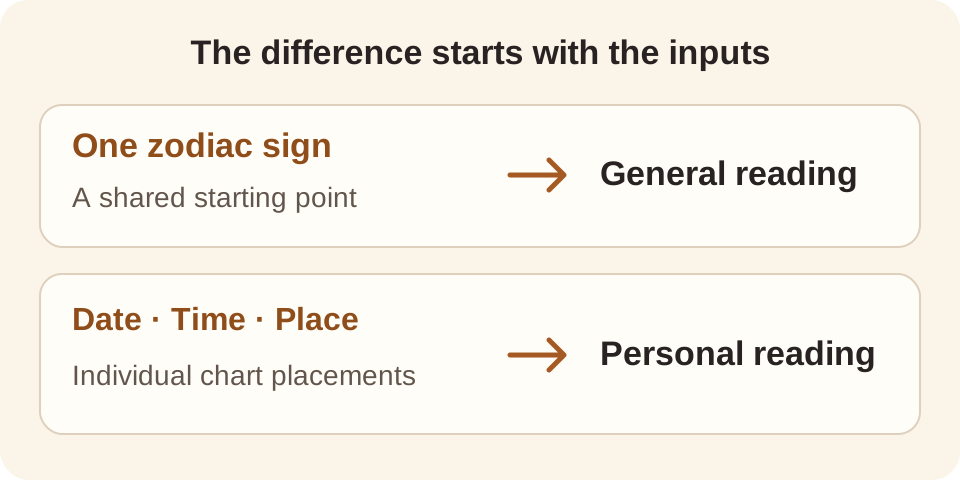
The differences at a glance
| What matters | General sign horoscope | Personalized chart reading |
|---|---|---|
| Starting information | Usually a Sun sign or Moon sign | Birth date, birthplace and, when known, birth time |
| Who shares the reading | Everyone reading for that sign | People with the same chart details and settings |
| Chart context | Broad themes for one sign | Individual placements, houses when time is known, and relevant timing |
| Best use | A quick overview or reflection prompt | Exploring a question in the context of your own chart |
| What to check | Which sign and astrology tradition to use | Birth details, chart tradition, time certainty and forecast dates |
Some general horoscopes use a Moon sign or rising sign rather than a Sun sign. Check the publisher's instructions before deciding which one to read. A longer reading is not automatically more personal; the inputs and explanation matter.
A practical example: two people with the same sign
Imagine two people who both call themselves Aries. One has a confirmed birth time and is exploring a change at work. The other does not know their birth time and wants a broad overview of the month. A general Aries forecast gives both the same text.
A chart-based reading can use the first person's birth details to discuss placements and time-sensitive houses. For the second person, it should explain which details remain uncertain and avoid treating an assumed rising sign as confirmed. This is an example of different inputs, not a claim that a particular event will occur.
What DrAstro adds to the reading
DrAstro calculates a chart from your birth details using Swiss Ephemeris. You can explore Vedic and Western chart views, then read the explanations associated with your placements. The general story describes chart themes; a dated outlook adds the period it covers.
Where a reading includes “Why this applies to you,” open it to see the placements and periods behind an insight. That makes the explanation easier to assess than a personal-sounding sentence with no chart context. Our calculation methodology explains how the astronomical calculation and the interpretation fit together.
Which reading should you start with?
- For a quick, shared overview: browse the daily sign horoscopes. You do not need a birth time to read one.
- To understand your placements: start with the free birth chart guide, then enter your own details.
- If your Vedic and Western signs differ: use the chart comparison guide to check the zodiac reference and settings.
- For a specific question: start with your chart, identify the life area you want to explore, and check whether the reading is a general story or a dated outlook.
If you do not know your birth time
Leave the time blank rather than inventing one. The Ascendant and houses depend strongly on time and place, and the Moon can change signs during a birth date. An estimated time should be identified as an estimate. See why birth time matters for more detail.
What is free, and what may cost extra?
The core birth-chart calculator is free to use without signing up. You enter your details before exploring the chart. Some additional readings, saved-account features or paid services may require an account or purchase; use the price shown for the feature you choose.
Personalization makes the inputs more specific. It does not establish that astrology can reliably predict personal outcomes. Use the reading as a perspective alongside your actual situation and choices.
Frequently asked questions
What is a personalized horoscope?
A personalized horoscope uses details from an individual birth chart and the period being explored. It can consider more than one zodiac sign, including placements and houses when the birth information supports them.
Is a birth chart the same as a horoscope?
A birth chart maps celestial positions for a birth moment and place. A horoscope is an interpretation, which may be general for a sign or based on a personal chart and a stated period.
Can I get a personal reading without my birth time?
Yes, you can start without it. Time-sensitive details such as the Ascendant and houses remain uncertain, and some placements may change during the birth date.
Is a personalized horoscope more accurate?
It uses more individual chart information, but that is separate from evidence that astrology predicts events accurately. Check both the quality of your birth details and the explanation behind the reading.
Can I try the chart calculator for free?
Yes. The core chart calculator is free without sign-up. Additional readings, account features or paid services may have their own requirements and prices.
See the chart behind your own reading
Start with your birth details, then explore your placements and the explanations behind them.
Free core chart. No sign-up needed. Birth time is optional.